
About 60–70% of a Web3 project’s budget goes toward marketing. And that makes sense: in crypto, marketing isn’t a support function — it’s how liquidity, users, and community actually get built.
So let’s break it down: what crypto marketing actually is, how it works, which channels matter in 2026, and why the rules are fundamentally different from everything you know in Web2.
Crypto Marketing vs. Traditional Marketing
If you come from Web2, your first instinct is to apply what you already know: run Google Ads, hire an SMM specialist to post content 24/7, and push campaigns on Facebook and Instagram. Some of that still works. Most of it doesn’t transfer cleanly.
What’s the difference?
| What | Traditional Marketing | Crypto Marketing |
|---|---|---|
| Main goal | Awareness + sales conversion | Trust + community + adoption |
| Primary audience | Consumers, B2B buyers | Crypto-native users, skeptical by default |
| Paid ads | Google, Meta, YouTube — all open | Restricted on most major platforms |
| Influencers | Reach + aesthetics | Trust + niche relevance + audience quality |
| Community | Nice to have | Core distribution channel |
| Timescale | Campaign-based | Continuous — community doesn’t stop |
| Trust signals | Brand name, reviews, media | Track record, transparency, KOLs, code |
Why crypto audiences are harder to convince
It’s no wonder that in Web3 chat rooms, users write things like “we’re in the trenches” or “we’re on the front lines”—because sometimes that’s exactly how it feels. You’ll encounter users who’ve survived Terra Luna, FTX, and scammers at every turn, and to sell even a clean apple to this audience, you have to wash it right in front of them, cut it open, and taste it yourself first. The typical reaction will be skepticism, not curiosity.
The bottom line is that Web3 marketing isn’t about view counts. It’s about trust. You could have a million followers on Twitter and still inspire zero trust. Or you could get a single well-placed endorsement from a KOL with 20,000 followers and reach your entire community (true story).
What doesn’t work from the Web2 playbook?
Google Ads and Meta still restrict cryptocurrency advertising — you can run some campaigns, but the limitations are significant, and account suspensions are common. Cold outreach belongs in B2B, not Web3. Generic brand content gets ignored when the brand is two months old.
What works: A 5-minute ad for your project shown during a Twitch stream by a blogger with the audience you need will drive more traffic than six months of battling social media algorithms, SEO, and Google Ads combined.
How Crypto Marketing Actually Works
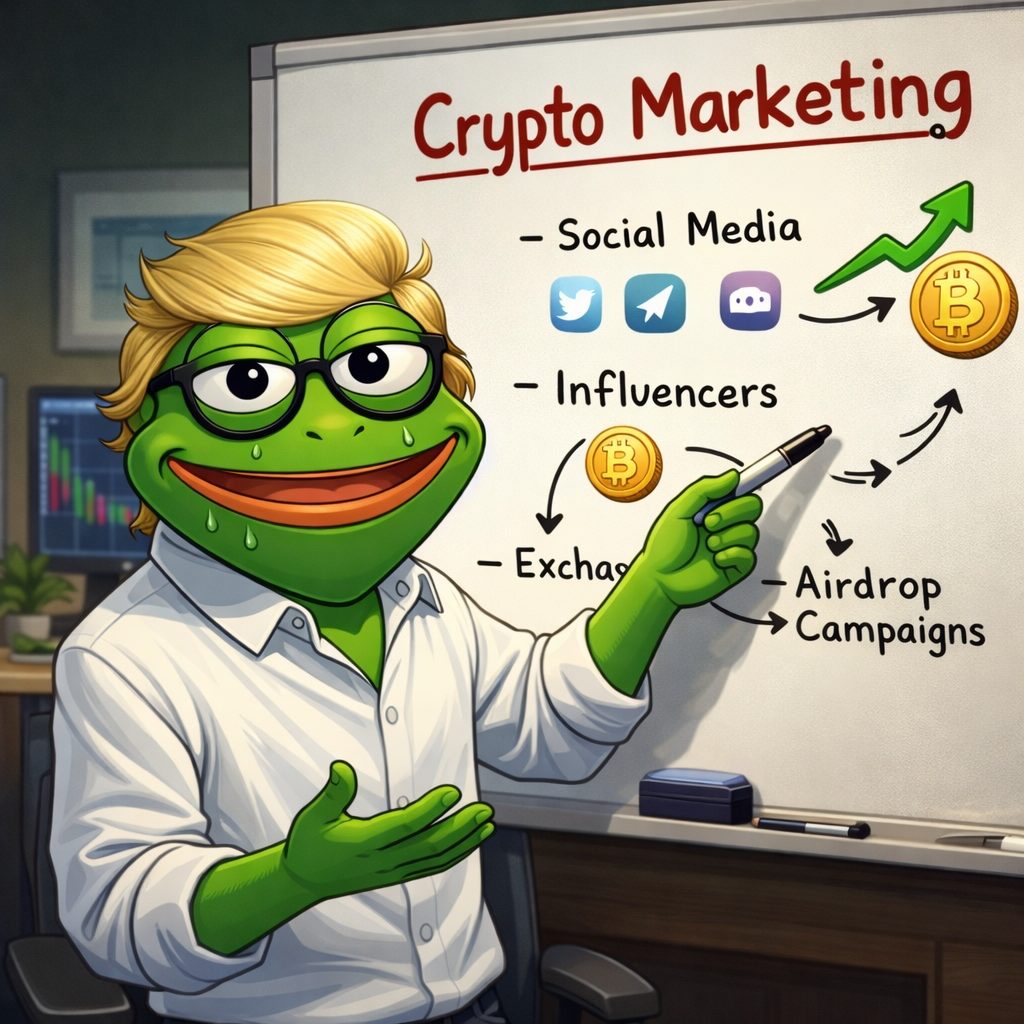
To put it simply, crypto marketing works like this: first, trust is built, and only then is action prompted.
In Web2, trust can often be bypassed with a large enough budget—enough impressions, enough social proof, enough retargeting, a few influencers recommending it—and you’re at the top even if your headphones are radioactive (also a true story). In Web3, such shortcuts largely don’t exist. The audience will dissect every detail of your project and even track down your first math teacher to check if you’re smart enough to calculate the tokenomics.
The trust-first model in Web3
Imagine that, without a thorough understanding of the field, a track record, and partnerships with industry insiders, no one needs you—and before you get any funding, you have to prove to everyone around you that you deserve it.
The marketing stack in Web3 is, in essence, a stack for building trust:
- Transparent communication, regular updates, and honesty about setbacks
- Educational content in which you explain what you do and why users need you
- Community engagement, activity, responsiveness, and accessibility
- Healthy partnerships with KOLs (find out what KOLs are here)
- Consistent delivery on promises
The Role of KOLs in Crypto Marketing
The abbreviation KOL stands for “Key Opinion Leader” (a more detailed description of what they are can be found here).
KOLs are one of the most effective channels for spreading information in the crypto space precisely because the crypto audience follows people, not brands. When a trader they trust mentions a product, it carries a weight that no advertisement can replicate. You can find crypto KOLs directly in the list on KYK.
An important distinction: A KOL with a small number of targeted followers who are native crypto users will often outperform a macro-influencer with 500,000 followers, whose audience consists mainly of Web2 users.
Community as a distribution channel
In Web3, the community always comes first because it’s not just an audience—it’s your distribution network and your primary promoters. Telegram groups, Discord servers, and X—that’s where the focus lies in the crypto world. Your community members promote your project better than any Google Ads campaign.
That’s why community building is a standalone marketing channel, not just a supporting function. A strong community of 5,000 active members can outperform a paid campaign reaching 500,000 passive views.
Main Crypto Marketing Channels in 2026

Here’s a practical breakdown of where attention lives in crypto right now, and what each channel is actually good for:
| Channel | Best For | Difficulty | Cost |
|---|---|---|---|
| X (Twitter) | Narratives, fast attention, market commentary | Medium | Low–Medium |
| Telegram | Community, retention, local audiences | Medium | Low |
| Discord | Developer communities, DeFi, NFT ecosystems | High | Low |
| YouTube | Education, trust-building, long-form explainers | High | Medium |
| KOL campaigns | Reach + credibility in one move | Medium | Medium–High |
| SEO & Content | Long-term organic, education, search intent | High | Medium |
| PR & Media | Legitimacy, institutional trust | High | High |
| Airdrops / Rewards | Initial traction, community growth | Low | Medium |
X (Twitter) — core
X is now the primary platform for promoting Web3, discussing market trends, and shaping public opinion. This is where influential KOLs build their audiences, projects announce news, and sentiment shifts in real time. If you’re not on X, you don’t exist in the crypto.
Telegram & Discord — community layer
Telegram serves as a hub for regional audiences, as well as communities of traders, arbitrageurs, and developers. Discord, on the other hand, is typically the platform of choice for developers. Both platforms function as the day-to-day operational backbone of the crypto community—it is here that segmented audiences from other channels often converge.
YouTube — long-form trust building
It is on YouTube where the real work takes place: engaging the audience, reviewing projects, conducting interviews, and sharing educational content. This helps build trust and cultivate a long-term audience. Growth may be slower, but it is more solid.
KOL campaigns — reach + credibility
A successful partnership with a KOL ensures both audience reach and credibility. Unlike paid advertising, a recommendation from a KOL comes with the trust that person has already earned from their audience. The key is to ensure that the KOL’s audience aligns with your target audience, rather than simply choosing the one with the most followers.
You can find crypto KOLs directly on KYK.
SEO & Content — long-term organic
Organic search isn’t very popular in Web3. Most projects focus solely on social media and don’t even consider the fact that thousands of people search for crypto-related information every day, and the scope of these searches is expanding daily. Creating educational content tailored to real search queries ensures steady traffic growth that doesn’t require ongoing expenses.
What Makes a Good Crypto Marketing Strategy?
Most resources on Web3 offer a list of tactical techniques. But that’s not a strategy. A strategy brings together your goals, your audience, and your choice of channels into a cohesive whole that moves in the same direction.
Start with the audience, not the channel
The most common mistake in crypto marketing is choosing channels before the founders have a clear understanding of their audience. Who exactly do you need? Traders, DeFi users, NFT collectors (if they still exist — this article is being written in March 2026), founders, or developers? They’re all like M&Ms — seemingly the same on the outside but entirely different inside, responding to different signals and needing different content.
First, define your audience. Then the choice of channel will become obvious.
Trust > Reach — why niche KOLs win
A large account focused on cryptocurrencies in general might have 300,000 followers. A niche blogger covering BNB-specific updates, on the other hand, might have 18,000. If your product is directly related to the BNB ecosystem, an account with 18,000 followers will almost certainly yield better results—after all, this audience is your target audience, and they trust this particular author.
In Web3, the quality of attention matters more than the quantity.
Tracking & measurement in Web3
This is where most cryptocurrency marketing campaigns fall flat: people burn through all their money, achieve “incredible results,” but have no idea what actually worked. Basic tracking is essential:
- Unique referral links for each KOL or campaign (UTM tags)
- Separate landing pages based on traffic source
- Referral codes, where possible
- Assessment of user quality after the campaign ends, not just their quantity
Views and impressions can lie. What you really need to know is which specific channel brought in the users who stayed on the platform, made a deposit, or converted.
Real Crypto Marketing Examples
Okay, unfortunately, projects aren’t very keen on sharing actual conversion rates or real-world scenarios, but here are a few examples (subject to NDAs) of how seemingly minor actions and expenses can impact the overall situation.
Crypto Wallet
- The only thing that was launched was an influencer campaign with a referral system
- Over 15 million was raised for the project in the first month
Staking platform
- Through influencers, the platform reached $13 million in TVL
- Token
Over $5 million was raised from just one post in exchange for 10% of the total pool
Coinbase — Content Marketing
Coinbase launched a newsletter called Coinbase Bytes—a weekly cryptocurrency news update sent directly to subscribers. This helped the company attract new users, promote its products, and keep its audience engaged between market cycles. Simple format, consistent execution, growing audience.
Stellar — Airdrop as an attention engine
In 2018, Stellar entered into a partnership with Blockchain.com to conduct a $125 million airdrop of Stellar Lumens tokens directly to wallet users. The goal was to attract attention and encourage real users to try out the token. This airdrop, one of the largest in cryptocurrency history, allowed Stellar to make a name for itself among a huge new audience.
Ripple — Paid campaign with storytelling
Ripple’s 2020 “Got It” campaign featured real people sending money and enjoying the speed of transactions (Web3 solves exactly this problem). Thanks to this narrative approach, the technical product became tangible. This allowed awareness to extend beyond the audience already familiar with cryptocurrencies and reach a broader mainstream audience.
KYK — conversion from the community
Over a long period of time, we have built a community that consistently converts more than 10% of its audience from a regular Telegram channel into regular users.
FAQ
What is crypto marketing?
Crypto marketing is the process of promoting cryptocurrency projects to build trust, attract users, and drive adoption of Web3 technology. It combines standard digital marketing methods—SEO (minimal for now), content marketing, email newsletters, and social media—with Web3-specific approaches, such as partnerships with KOLs, building communities on Telegram and Discord, token-based incentives, and transparent communication.
How is crypto marketing different from regular marketing?
The core difference is the role of trust. Crypto audiences are more skeptical, more research-oriented, and far less responsive to traditional advertising than any Web2 audience you’ve dealt with. Paid advertising is restricted on most major platforms. Influencer marketing works differently — niche relevance and audience trust matter more than follower count. The community is a distribution channel, not just a support function.
What channels work best for crypto marketing in 2026?
X (Twitter) remains the primary platform for sharing information and capturing attention. Telegram and Discord serve as platforms for building communities and retaining audiences. YouTube is suitable for hosting in-depth educational content. Campaigns featuring KOLs simultaneously ensure audience reach and credibility. SEO and content marketing generate organic traffic that grows over time and does not require ongoing expenses.
How much does crypto marketing cost?
This largely depends on the approach. A campaign involving KOLs and niche micro-influencers can cost anywhere from a few thousand dollars to hundreds of thousands or even millions, especially when dealing with major KOLs, but there’s a 90% chance you’ll be paying on a partnership basis. However, larger-scale campaigns using popular accounts can cost anywhere from $20,000 to $100,000, but in this case, payment is more likely to be upfront in stablecoins. Community building and content marketing are less expensive but require ongoing investment: SEO—$600–$1,200 per month; SMM—$500–$900 per month. The cost of PR campaigns and media placements varies significantly by media outlet and format—ranging from tens to hundreds of thousands—but here you need to consider the limitations of each outlet.
What is a KOL in crypto marketing?
A key opinion leader (KOL) in the cryptocurrency space is someone who influences the Web3 audience through trust, expertise, and authority—not just through the number of followers. These can be traders, analysts, educators, founders, or community leaders. The main thing is that their audience listens to them and acts on their recommendations. Read more about “Who is a crypto KOL?” here.
Can a small crypto project compete with big marketing budgets?
That’s right—and this is precisely where Web3 stands out most clearly from Web2. Community-focused approaches, partnerships with niche thought leaders, and consistent educational content can prove more effective than paid campaigns, while costing several times less. The reason is that trust doesn’t depend on the size of the budget. A small project with a real team and genuine engagement with the community can earn more trust than a project with substantial funding but a polished yet hollow marketing machine.